
How to Find Emerging Abstract Artists Before Their Work Becomes Harder to Access
There is a particular kind of regret that collectors know well: discovering an artist after the window has already closed. The prices have moved. The waiting lists are long. The intimacy of the early work, the direct access to the artist, the sense of being present at the beginning of something, all of it is gone. What remains is the secondary market, the gallery markup, and the feeling of having arrived too late.
The good news is that the signals worth watching are learnable. Collecting emerging abstract art well is not about insider access or predicting who will become famous. It is about developing the ability to recognize a serious artistic practice while the work is still accessible, personal, and evolving.
The most reliable sign of an emerging artist worth following is not a single show, a viral post, or a gallery co-sign. It is a coherent body of work sustained over time.
This guide breaks down exactly what that looks like in practice, where to look, and how to move with confidence once you find it.
Start With the Body of Work, Not the Single Piece
Most collectors discover an artist through one painting. That is fine. But the first question to ask is not "do I love this piece?" It is: "does this piece belong to something larger?"
Abstract art is particularly vulnerable to one-off novelty. A striking surface, an unusual palette, an unexpected combination of materials, any of these can produce a single compelling work without signaling a lasting practice. The artists who build enduring careers are the ones returning to a set of concerns repeatedly, pushing them further with each new painting rather than chasing a new effect.
What Consistency Actually Looks Like
Consistency is not repetition. It is the presence of a recognizable question running through a body of work, even as the handling of that question evolves. Look for:
A stable set of materials and methods that the artist has committed to and deepened over time
Recognizable authorship: you could identify an unlabelled piece as theirs from across the room
Development rather than restlessness: the work shifts, but not because the artist is chasing attention or trends
A clear through-line across scales: the same sensibility visible in a small study and a large canvas
An artist who changes their entire approach with each new series is often still searching. That is not a disqualifier, but it is a reason to watch rather than buy. The artists worth collecting early are the ones who have already found their question and are committed to the exploration.
Why This Matters More in Abstraction
In representational work, subject matter can carry a painting even when the underlying practice is thin. Abstraction offers no such cover. Without a figure, a landscape, or a recognizable scene to anchor the viewer, the work has to succeed entirely on its own terms: through color relationships, surface, composition, and the quality of attention the artist brings to each decision.
This is why a coherent body of abstract work is a particularly strong signal. It means the artist has developed a visual language specific enough to be recognizable, and rigorous enough to hold up across multiple paintings. That kind of consistency is genuinely hard to fake.
Read the Materials and the Surface
How an artist builds a painting reveals how they think. In abstract work especially, the choice of materials is not incidental. It is the content.
Layered surfaces, texture built up over multiple sessions, collage elements, unexpected combinations of acrylic, oil, and textile, these are not just aesthetic choices. They are evidence of a sustained process. A painting that rewards close looking, that changes as you move around it or return to it over weeks, is a painting that was made with intention over time.
"The most compelling work often rewards time and changes as you live with it."
This is one of the most useful tests a collector can apply before buying: spend ten minutes with the work. Does it give you more the longer you look? Or does it reveal itself entirely in the first thirty seconds? Work with genuine depth, built through process and layering, almost always has more to offer on the third look than the first.
Signals Worth Noting in the Studio Practice
When researching an artist, pay attention to how they talk about their materials. Artists with serious practices tend to be specific about their process: which surfaces they work on, how they build layers, what decisions they make and revise. Vague language about "following intuition" can mean genuine spontaneity, but it can also signal a practice that has not yet developed its own rigor.
Look for:
Process documentation: studio shots, works in progress, evidence of revision and reworking
Material specificity: a clear sense of why they use what they use, not just what they use
Scale as a deliberate choice: large-scale work in particular demands physical commitment and compositional control that smaller work does not
The surface of a painting is the record of a process. Learn to read it.
Understand What Pricing Signals
Price is not a proxy for quality, but it is a signal worth reading carefully. An artist does not need to be expensive to be serious. What matters is whether the pricing reflects an intentional practice and a growing body of evidence that others are paying attention.
The Pricing Progression to Watch
Thoughtful, consistent pricing usually indicates that an artist has developed a clear sense of their own market position. Prices that scale logically with size, that increase gradually over time as demand grows, and that hold steady rather than fluctuating wildly, all suggest an artist who is managing their career with intention.
Signal
What It Suggests
Prices consistent across similar works
Intentional practice, not reactive pricing
Gradual increases over time
Growing demand, not artificial inflation
Pricing that reflects scale and materials
Artist understands their own market
Available work with clear documentation
Professional approach to the practice
Red flags are equally readable. Prices that seem randomly assigned, significant discounts offered immediately, or a wide range with no clear logic can suggest an artist still figuring out their relationship to the market, or one who is primarily motivated by making a sale rather than building a practice.
Buying Directly From the Artist
Purchasing directly from an artist carries advantages that go beyond price. You get the cleanest possible provenance, a direct line of ownership from studio to collection, which matters both now and later. You also get context: the story behind the work, the artist's own understanding of what it is doing, and the beginning of a relationship that can deepen over time.
Artsy's guide to collecting emerging art notes that "when you collect with passion, the connection to the work and the psychological reward exceeds the financial aspect." The most satisfying collections are built on genuine engagement with artists and their practices, not on speculation about future prices.
The real question is not whether a work will appreciate. It is whether you want to live with it now, and whether the artist making it is building something worth following.
Look for Institutional Attention
Gallery representation, press coverage, and social media following are useful signals, but they are also gameable. Institutional attention is harder to manufacture.
When a museum acquires an artist's work, it is making a considered, public commitment. Institutions move slowly and stake their credibility on their choices. A museum acquisition does not guarantee future market success, but it does confirm that people with deep expertise and long time horizons have looked carefully at the work and decided it belongs in a permanent collection.
The same logic applies to juried exhibitions and curated group shows. Being selected by someone with a reputation, rather than self-organizing a show, carries weight precisely because it represents external validation of the work's quality and relevance.
Other Institutional Signals Worth Noting
Inclusion in public or corporate collections: work placed in institutions, embassies, or significant private collections suggests the work holds up under scrutiny
Exhibition history that deepens rather than just lengthens: a decade of consistent showing, not a burst of activity around a single launch
Critical writing: reviews in publications with editorial standards, not just press releases or artist-written statements
Selection for residencies: competitive residencies indicate that a community of peers and professionals has evaluated the practice and found it serious
None of these signals is sufficient on its own. An artist can have strong institutional credentials and work that leaves you cold. But when institutional attention aligns with a coherent body of work and a process that rewards looking, it is a meaningful confirmation.
Where to Look: Finding Emerging Abstract Artists Before the Crowd Does
The discovery phase matters as much as the evaluation phase. Knowing what to look for is only useful if you are looking in the right places.
Online Platforms
Instagram remains the most direct channel for finding artists before they have gallery representation. Following working artists, curators, and smaller galleries, and actively breaking out of your algorithm by exploring tagged communities like #abstractpainting or #mixedmediaart, can surface work that has not yet been amplified by the market.
Platforms like Artsy are useful for understanding the broader landscape and discovering galleries with strong emerging artist programs. The key is to use them as research tools, not as the only lens.
Physical Spaces
Artist-run spaces, open studios, and smaller regional galleries often show work before it reaches the larger art fair circuit. MFA thesis exhibitions are another underused resource: galleries pay close attention to these shows, and the work is often available directly from the artist at accessible prices.
The advantage of seeing work in person cannot be overstated. Photographs, even excellent ones, cannot fully convey surface, scale, or the way a painting holds light. For abstract work especially, the physical experience of standing in front of a painting is different in kind, not just in degree, from looking at a screen.
The Artist's Own Studio and Website
When an artist maintains a clear, well-organized online presence with consistent documentation of their work, it is itself a signal. It suggests a professional approach to the practice and a commitment to making the work accessible to collectors.
A strong artist website will show a coherent body of work across multiple years, clear documentation of each piece including materials and dimensions, and some indication of exhibition history or institutional recognition. These are the same signals you would look for in person, made visible through the quality of how the artist presents themselves online.
Whitney Nye: What These Signals Look Like in Practice
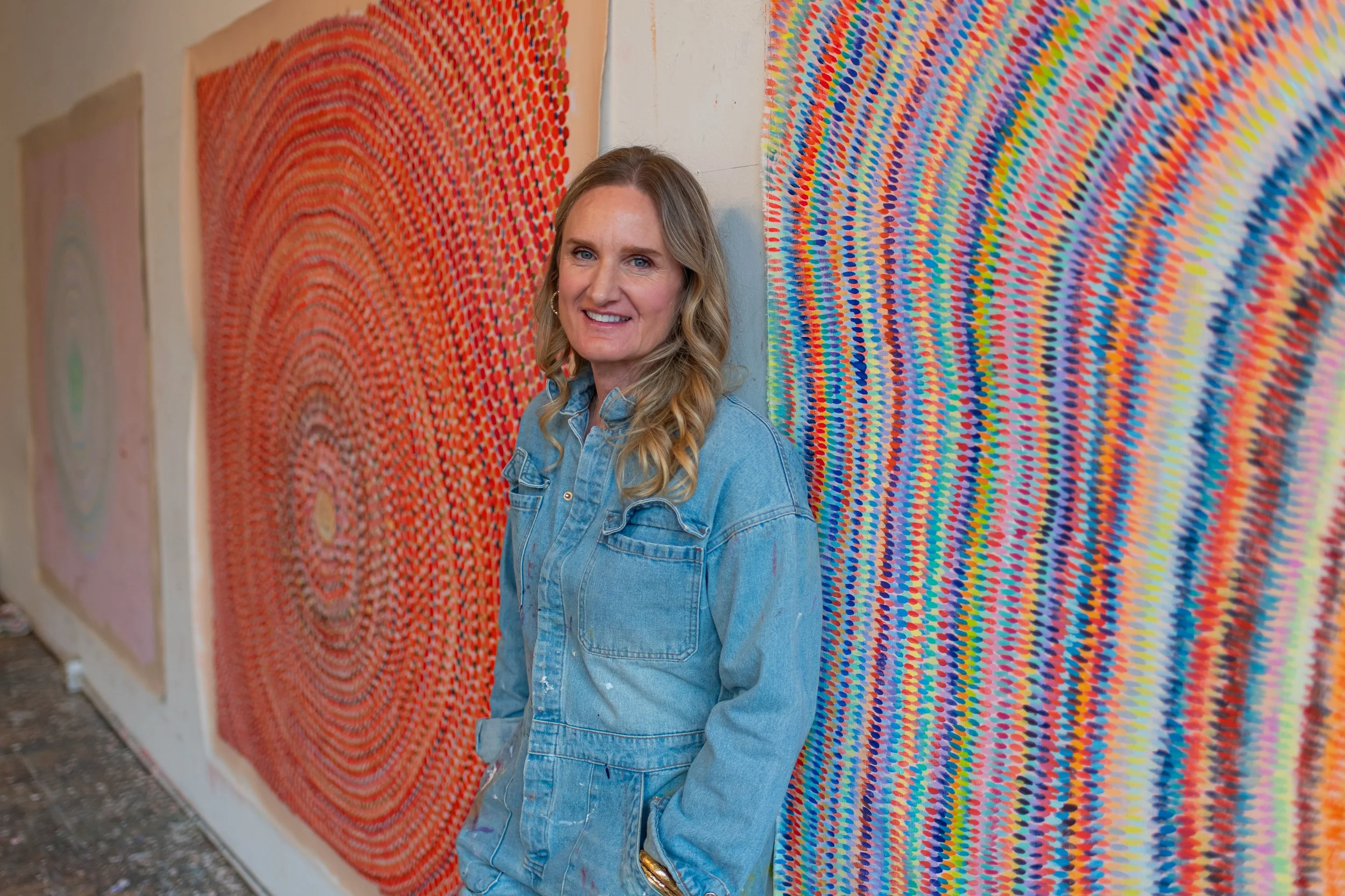
Abstract principles are most useful when they are grounded in a specific example. Whitney Nye, a Portland and New York-based mixed-media painter, offers a clear illustration of what the signals described above look like when they converge in a single practice.
A Coherent Body of Work Across Decades
Nye's work spans large-scale paintings on canvas and panel using acrylic, oil, and textile, materials she has worked with consistently over a long career. The visual language across her body of work is recognizable: layered compositions that build depth through texture and color, surfaces that shift and reveal themselves over time, and a scale that commands physical space rather than simply occupying it.
This is not a practice assembled for a single show. It is the record of an artist who has been asking the same questions, with increasing rigor, for years.
Institutional Recognition
In 2013, the Jordan Schnitzer Museum of Art at the University of Oregon acquired Nye's work and included it in their exhibition Celebrating Oregon Artists, a show highlighting recent additions to one of the Pacific Northwest's most significant permanent collections. Her work has also been featured in the U.S. Embassy in Bandar Seri Begawan as part of a cultural exchange program, placing it in the company of work selected to represent American artistic achievement internationally.
These are not vanity credentials. They are the result of external evaluation by institutions with reputations to protect.
Available Work at This Moment
What makes Nye's practice particularly relevant for collectors right now is that original works are still available directly, at a stage when the access is still personal and the relationship between collector and artist is still possible.
Her current collection includes large-scale oil on canvas works that demonstrate exactly the qualities worth looking for: a layered surface that rewards extended looking, a clear visual language across multiple pieces, and the kind of physical presence that photographs can only approximate.